
This article was created using a translator. There may be expressions that are difficult to understand. If you have any questions, please check by yourself.
Please consult us about anything related to Fujieda City.
CONTACTWell, leaving Kuwana-juku behind, I’ve arrived at Yokkaichi. When people hear “Yokkaichi,” I think most imagine an “industrial zone,” but it actually seems it was quite a sizable post town along the Tōkaidō highway back in the day.
Places I usually just zip past in my car—I’ve been exploring them by rental bike each time and discovering, “Oh, there was a place like this!”
So this time, I’ll be taking a leisurely stroll through the old Tōkaidō’s “Yokkaichi-juku” and introducing its history and highlights.
What’s Yokkaichi-juku like?
Yokkaichi-juku was the forty-third post station along the Tōkaidō’s fifty-three stations.
Geographically, it followed Kuwana-juku and thrived as a gateway to the sea from Kuwana and as an entrance point for travelers heading toward Ise.
The origin of its name is simple: it seems to come from “Yokkaichi” (fourth day market), as a market was held on the fourth day of every month.
The town developed from this market, eventually becoming a post station. During the Edo period, it was a very lively area bustling with goods transport and travelers.
What was remarkable about Yokkaichi was that it combined two roles: a “land route post station” and a “seaport town.”
People walking the Tōkaidō, pilgrims heading to Ise, merchants traveling for business… all kinds of people passed through, contributing to the town’s vitality.
The post station was fairly large in scale, featuring one honjin (main inn), one wakihonjin (auxiliary inn), and around 40 ryokan inns. It was truly a post station where lodging was never a problem.
Serving as a central hub for northern Mie Prefecture, it was also a strong merchant town, a place where diverse cultures intermingled.
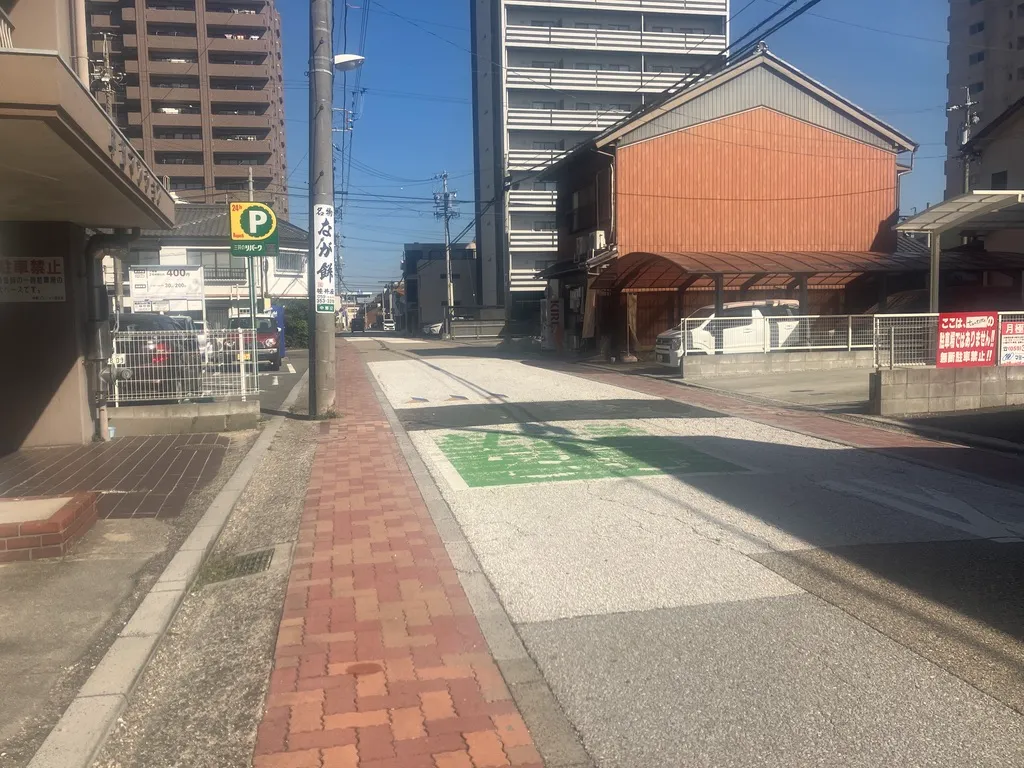
Digging a Little Deeper into the History of Yokkaichi-juku
Yokkaichi became historically significant primarily because a market (“ichi”) was established here, and due to its coastal location.
In the past, maritime transport via Ise Bay flourished, allowing the town to develop not only as a land logistics hub but also as a key maritime transit point.
Later, when the Tōkaidō highway was formalized during the Edo period, Yokkaichi was officially designated as a post station (“juku”), taking on both the role of a port and a lodging town.
It was particularly bustling as a major thoroughfare for daimyo processions during sankin-kotai, pilgrims heading to Ise, and merchants.
Another crucial factor was Yokkaichi’s influence under the Kishu Domain, one of the Tokugawa Gosanke (Three Households).
This entire region served as a rice storage area for the Kishu Domain and housed a magistrate’s office, functioning as a key political and economic hub.
The Tokugawa Gosanké (御三家) were three branch families of the Tokugawa clan during the Edo period. They held a rank immediately below the main branch, the Shōgun family, and were permitted to bear the Tokugawa surname. They are also simply called the Gosanké (御三家) or the Sanké (三家). Generally, they refer to the Owari Tokugawa family (Owari-ke), the Kii Tokugawa family (Kii-ke), and the Mito Tokugawa family (Mito-ke), each founded by a son of Tokugawa Ieyasu, the first shogun of the Edo shogunate. However, these three families were not clearly treated as the “Three Houses” from the outset (as discussed later).
wikipedia
Beyond its function as a post town, it also served as an “administrative center.” This background explains why it was “well-developed and commercially strong for a post town.”
Looking at the current streetscape, it seems like modernization happened all at once, but actually, it had been a “commercial town” since the Edo period.
Highlights of Yokkaichi Inn
Here are a few spots I actually visited while huffing and puffing on my bike.
Suwa Shrine · Sacred Vow Pillars
Suwa Shrine stands at the heart of Yokkaichi-juku.
Though located right in the middle of the city, stepping into its grounds brings a sudden shift in atmosphere, making it clear this is a shrine long cherished by the local community.
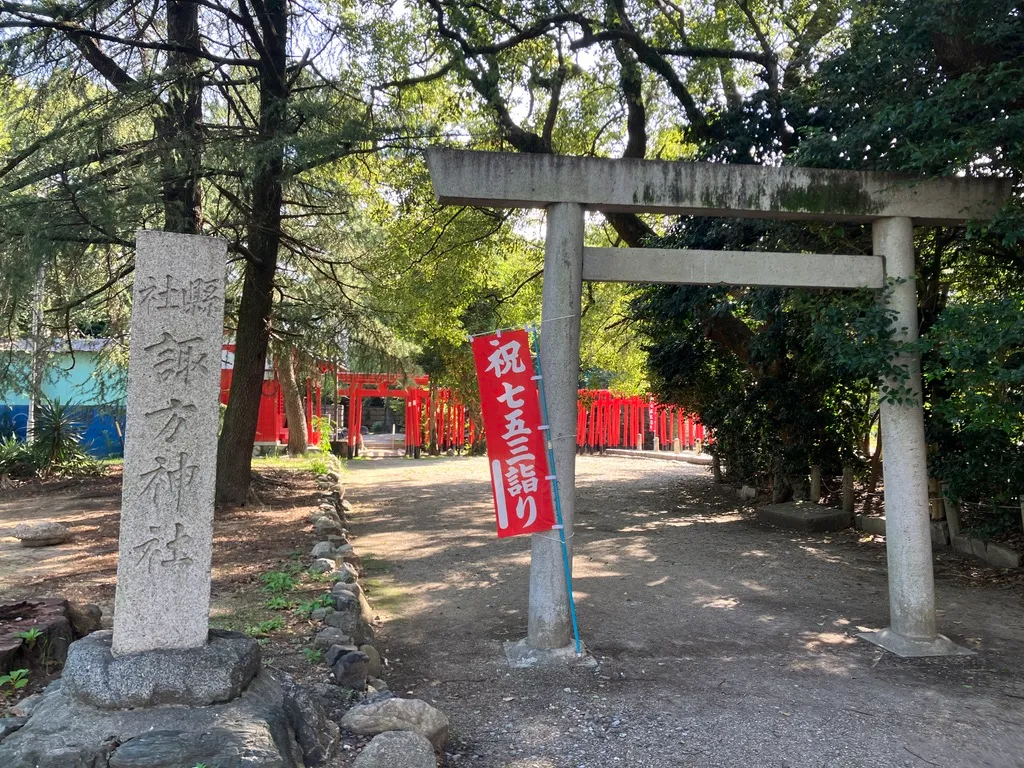
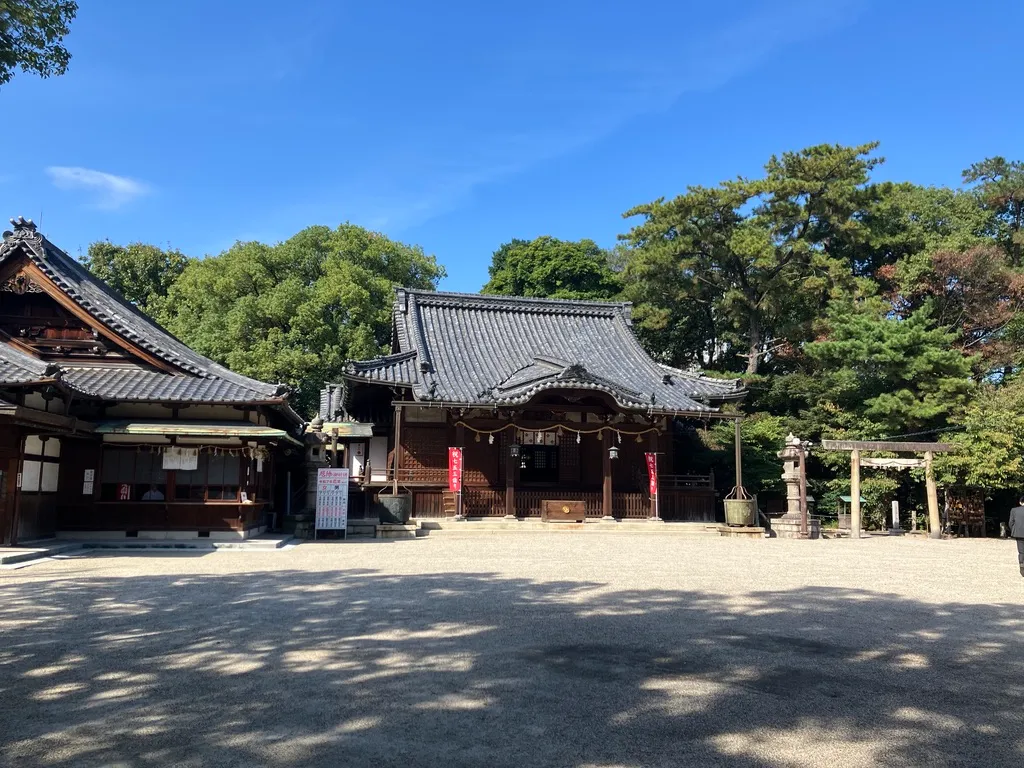
The highlight here is undoubtedly the “Oath Sacred Pillars.”
Just hearing the name makes you think, “What’s that?” But simply put, Wikipedia says it’s “a monument symbolizing the Five Articles of Oath.” Apparently, there are only five such sites left in the country now.
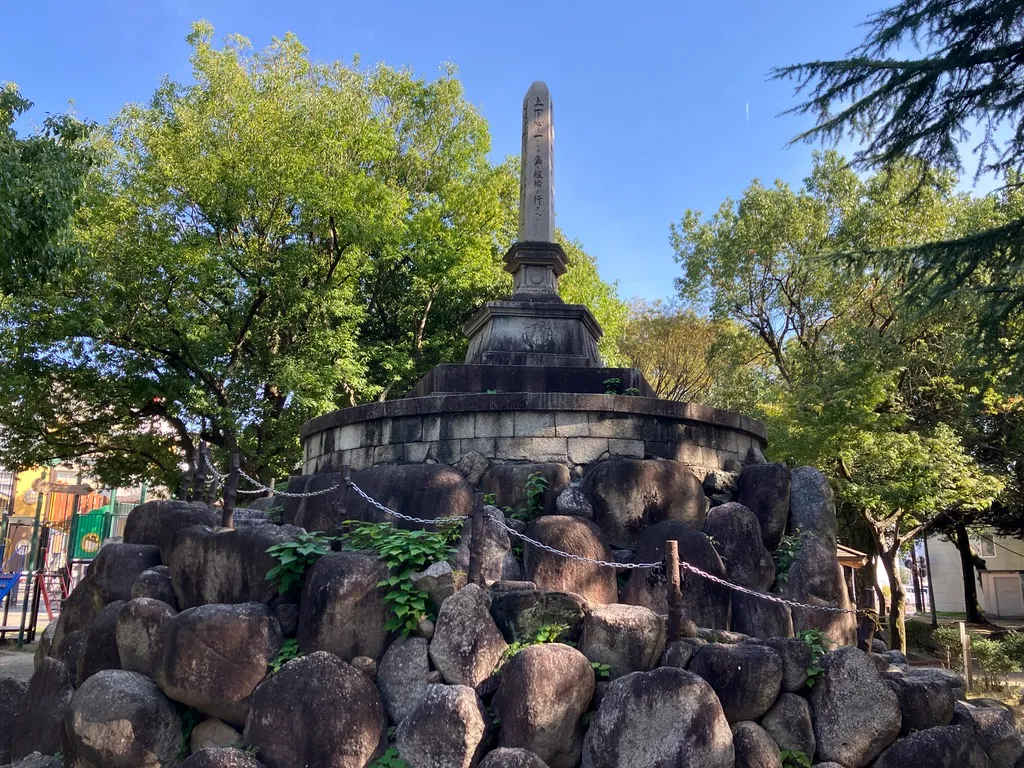
The Sacred Pillars of the Oath (Chikai no Mihashira[1]) are monuments symbolizing the Five Articles of the Imperial Oath[2]. Each face of the pentagonal spire is engraved with one of the articles of the Oath[3]. At least seven were constructed between 1926 and 1934[4]. Of these, the following five locations are confirmed to still exist: Takegashima Island on Lake Biwa[5][6], Aichi Prefectural Handa High School[7], Otogawa Hakusan Park in Handa City, Aichi Prefecture[8], Kanpu Mountain in Oga City, Akita Prefecture[9], and Suwa Park in Yokkaichi City, Mie Prefecture[10]. They are rare monuments, with only a few remaining within Japan[9].
The grounds aren’t particularly large, but they’re packed with the weight of history and the devotion of the local people. Close to the shopping district, it’s also the perfect starting point for exploring the old post town.
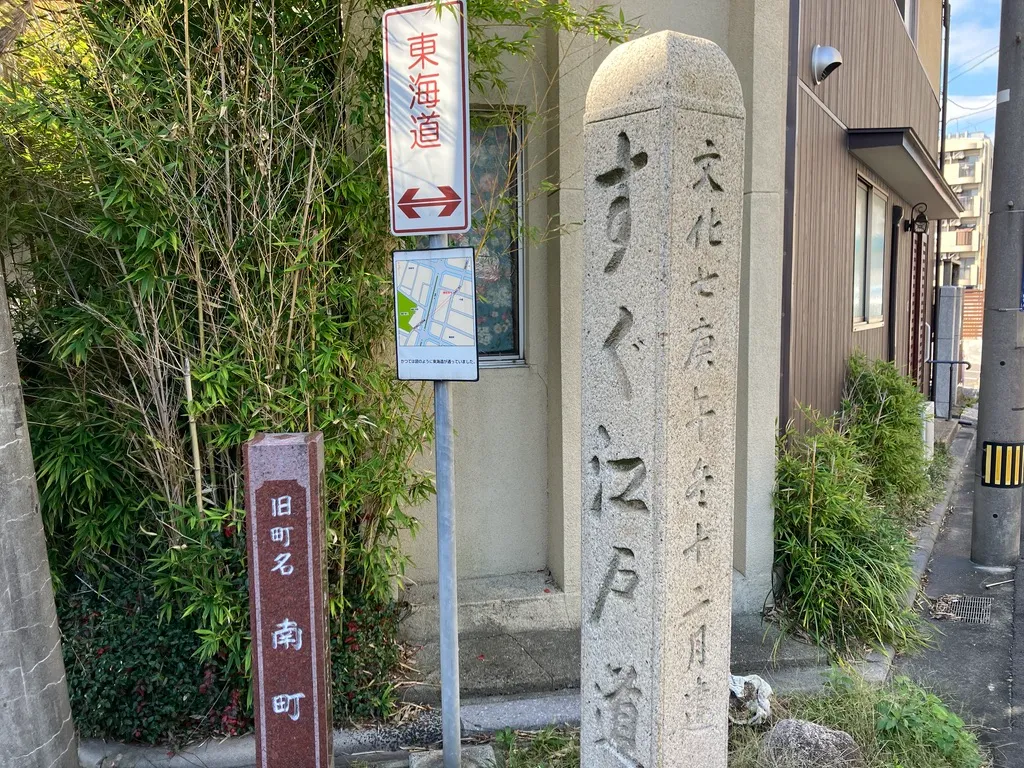
Road Markers (Old Tōkaidō)
Dotted along the old Tōkaidō are “road markers.” Seeing these preserved instantly heightens that feeling of walking through a post town. Though unassuming, the thrill of exploring differs greatly between post towns that have them and those that don’t.
The road markers remaining in Yokkaichi-juku are mostly from the late Edo to early Meiji periods, and their greatest charm lies in preserving the original road guidance from that time.
Though the roads are now modernized with cars passing by, finding these stones suddenly makes you feel a breeze from the Edo period, adding a nice accent.
If you walk the old road, this is definitely a point where you should look for them as you walk.
Yokkaichi-juku Jinya Site (Yokkaichi Magistrate’s Office Site)
When discussing the history of Yokkaichi-juku, this site—the Yokkaichi-juku Jinya Site—is indispensable.
It was the administrative center of the post town, managing taxes, maintaining public order, and issuing directives to merchants and farmers.
Under the control of the Kishu Domain, the magistrate’s office was apparently quite large.
It makes you realize that the very foundation of Yokkaichi’s reputation as a merchant town was built upon this administrative presence.
While the buildings themselves no longer stand, an information board has been installed beside Yokkaichi Municipal Chubu Nishi Elementary School. It’s a spot that really drives home the point: “This was the heart of Yokkaichi.”

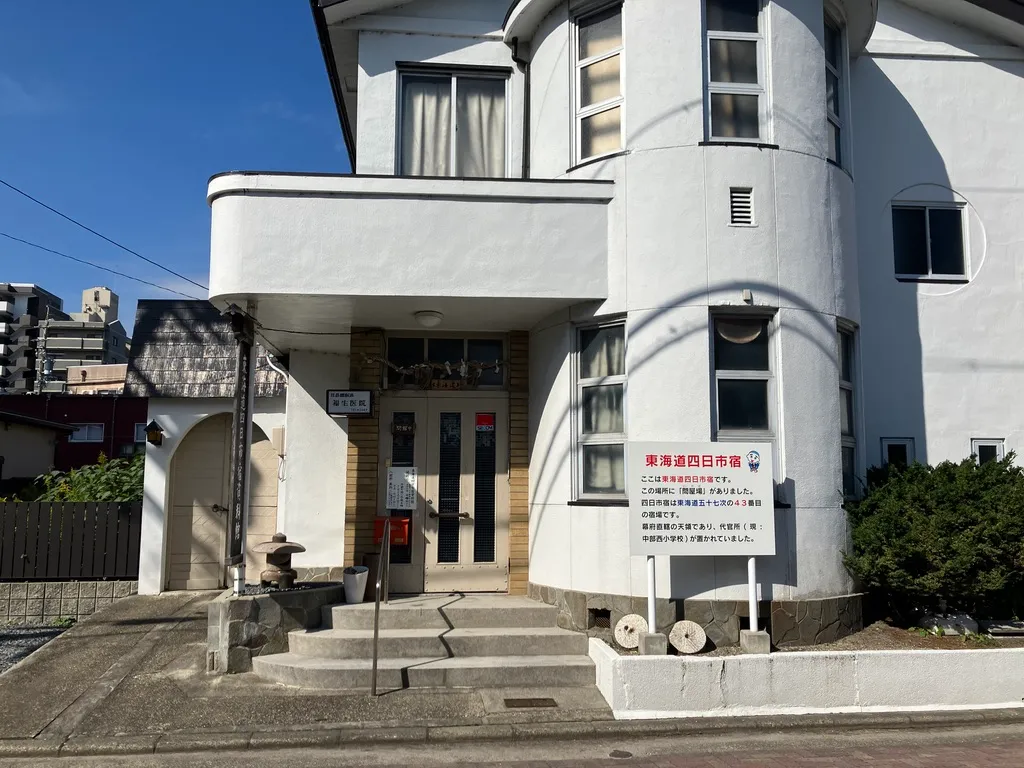
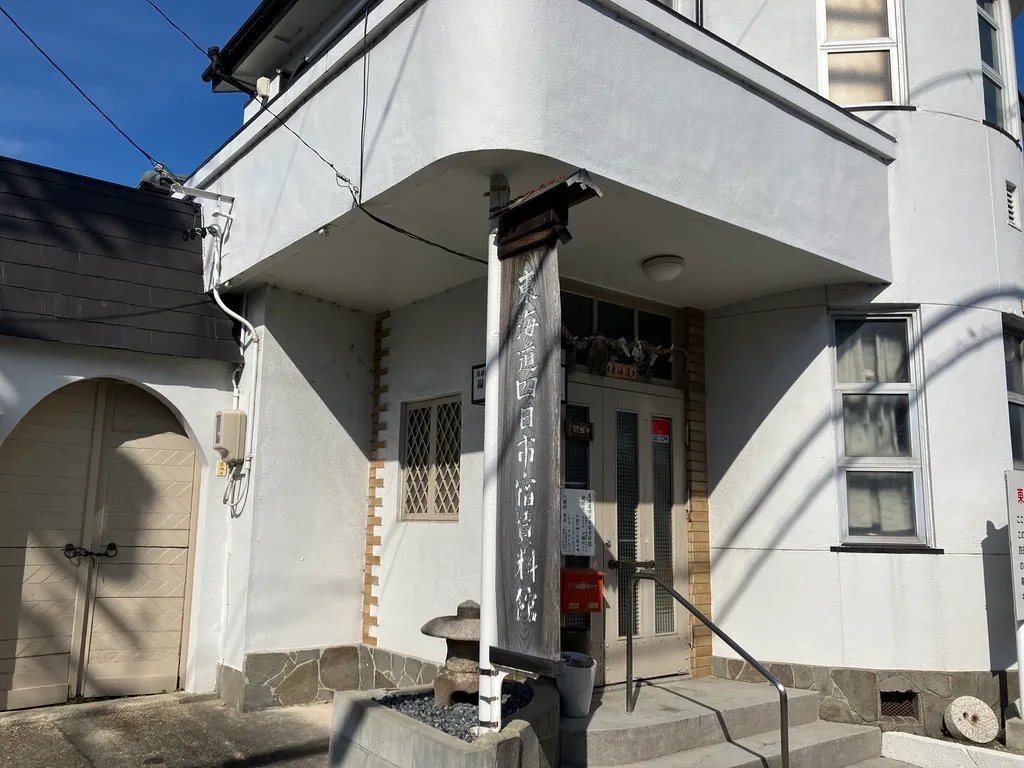
Tokaido Yokkaichi-juku Museum
This museum seems to convey the history and culture of the former post town Yokkaichi-juku (the 43rd post town along the Tokaido Road during the Edo period).
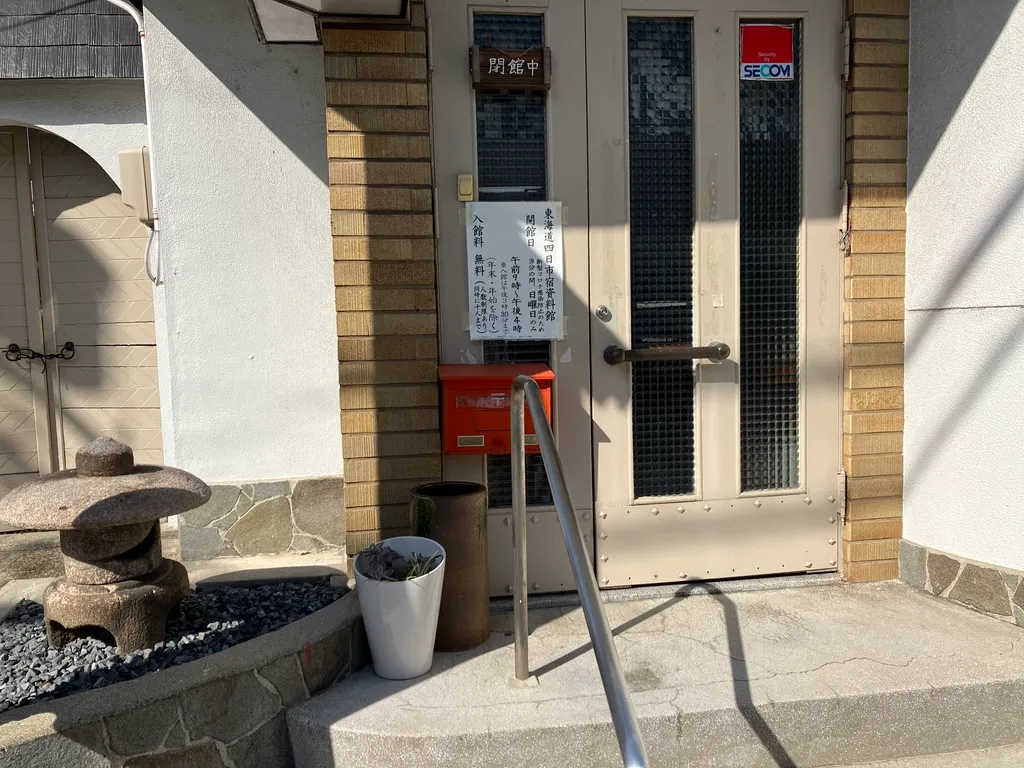
It appears to have been open regularly before COVID, but now it’s only open on Sundays, and it was closed when I went…
It was developed on the site of the former Fussa Clinic, an ENT hospital, which is also interesting and gives it a nice vibe.
I really wanted to see inside.
Admission is free, and it seems to house and display over 500 items, including historical materials from the Sengoku period through the Edo, Meiji, and early Showa eras, local folk culture, performing arts materials, and antique tools.
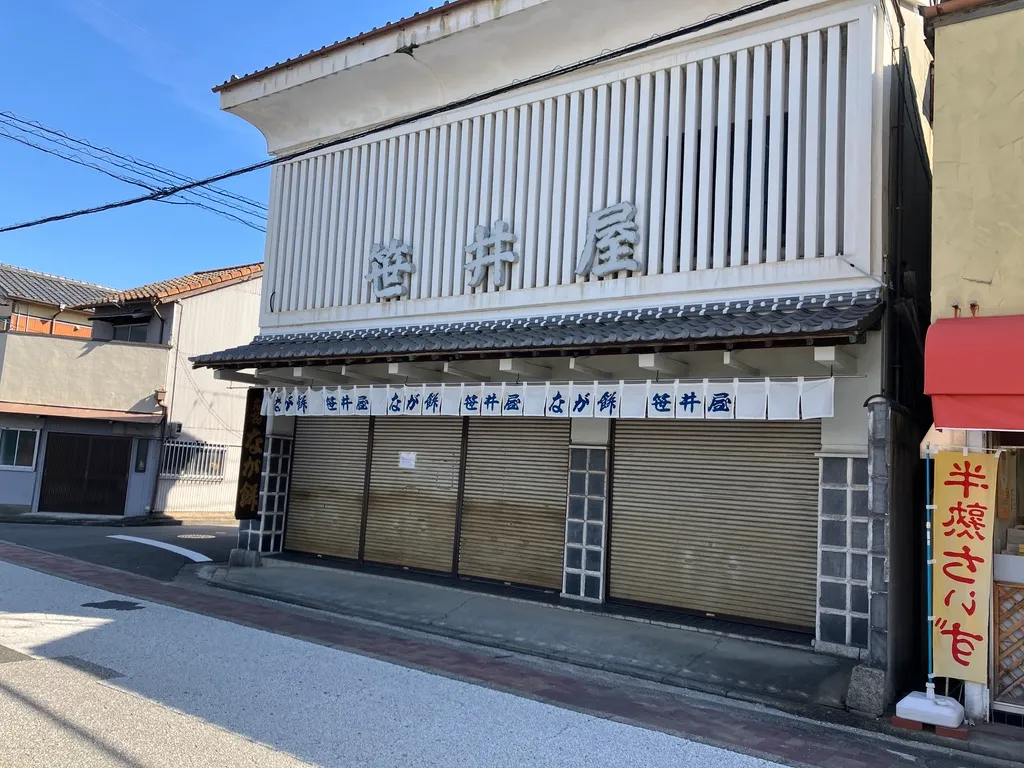
Nagamochi Sasaiya Main Store (This is the real deal Yokkaichi specialty!)
When it comes to must-try local specialties in Yokkaichi, “Nagamochi” is a must.
Sasaiya is a venerable old shop with over 450 years of history, and it seems to have been a huge hit with travelers walking the Tokaido Road since ancient times.
…I only found out after coming to Yokkaichi 💦
The following is from the official website of Nagamochi Sasaiya.
It seems to be less sweet, so even people who aren’t big on sweets should be able to polish it off.
For some reason, it was closed when I went by. Honestly, this happens a lot with my research on Tokaido post towns—I visit places only to find them shut down.
Tokaido Ukiyo-e Spot (Hiroshige’s World Still Remains)
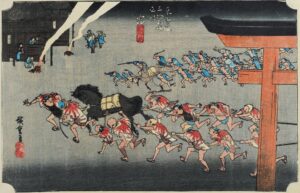
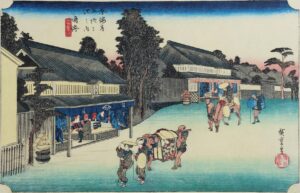
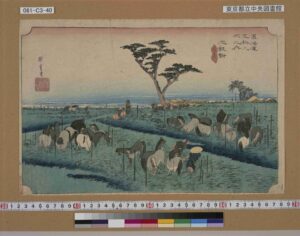
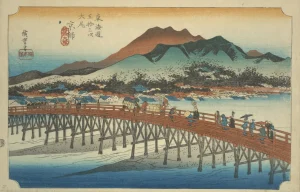
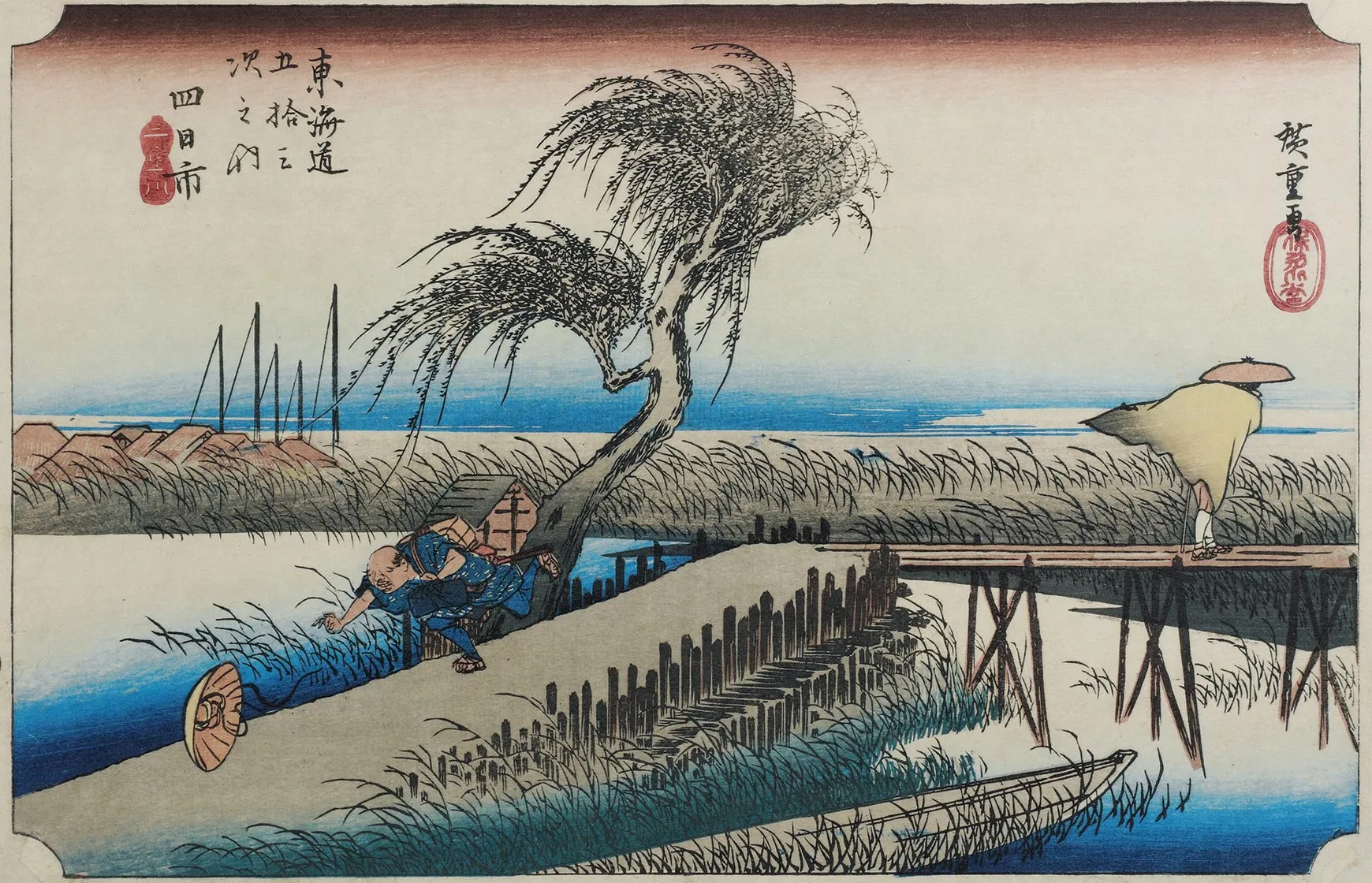
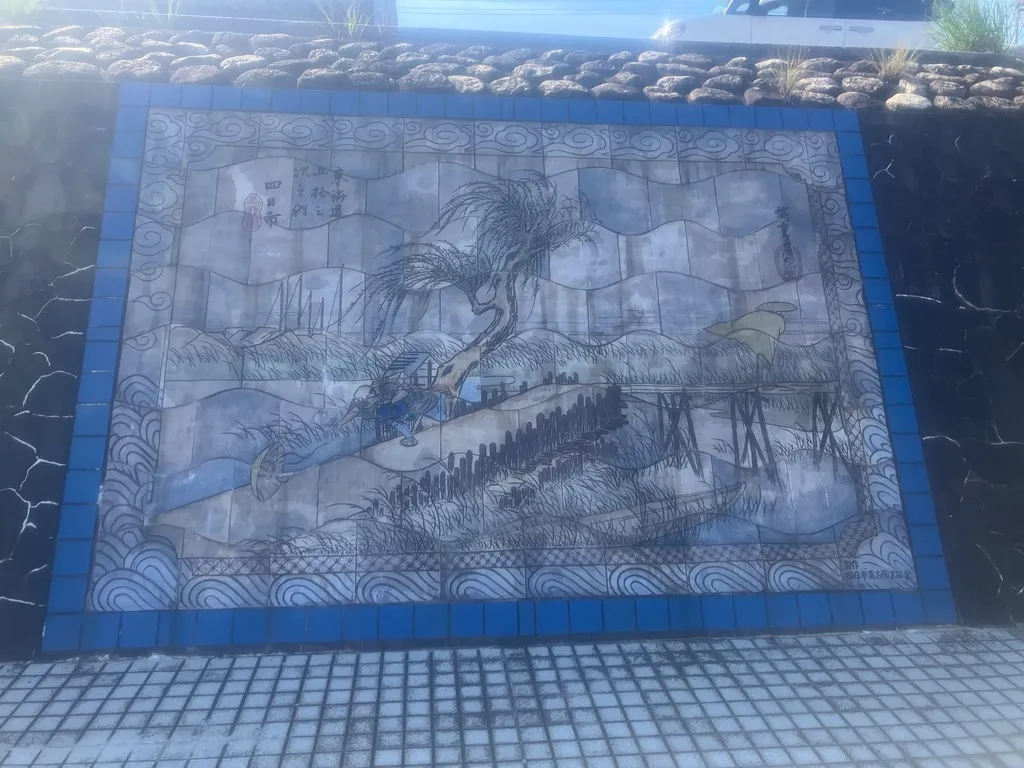
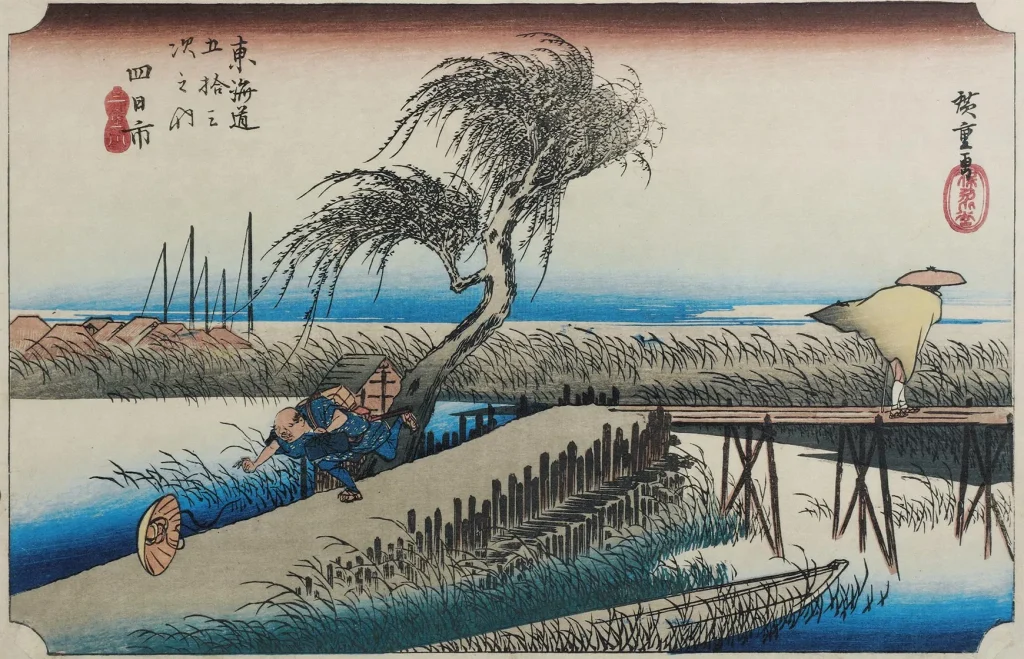
The scenery of Yokkaichi-juku is depicted in the famous series “Fifty-three Stations of the Tokaido” by Utagawa Hiroshige.
Hiroshige’s Yokkaichi is famous for its composition titled “Traveler Walking Along the Embankment of the Mitaki River” – the very ukiyo-e at the top of this page.
It depicts a tranquil riverside scene with locals crossing the river, beautifully capturing the simple charm of the post town.
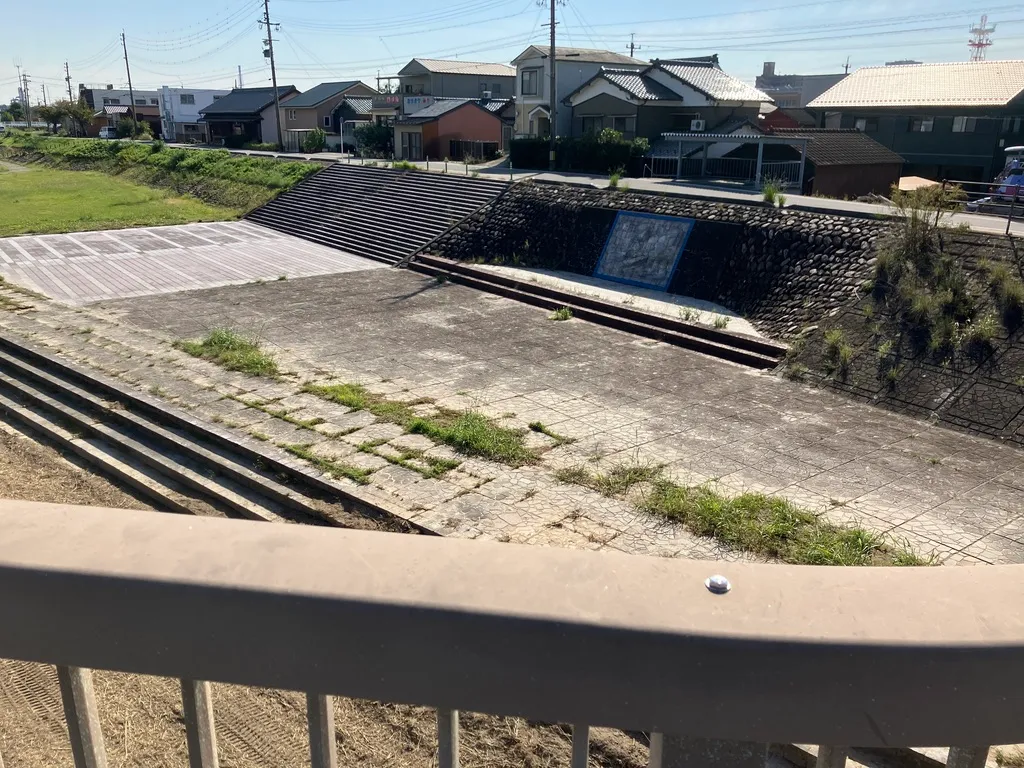
Here, an “Ukiyo-e Point” has been set up where you can take photos with the same composition as the ukiyo-e.
It’s a spot where you can feel a touch of romance, thinking, “Oh, so this is the world Hiroshige painted…”
…though I couldn’t figure out exactly which viewpoint matched the painting’s composition💦.
When ukiyo-e art intertwines with exploring the old Tokaido Road, the world suddenly becomes vivid, doesn’t it?
If you visit, I highly recommend comparing the spot with Hiroshige’s painting.
Summary: Yokkaichi-juku is a charming post town where history, commerce, and travel converge.
Honestly, Yokkaichi has such a strong industrial image that its post town history is often overlooked. But walking through it reveals profound depth.
A merchant town that grew from the city, a key junction for sea and land routes, a stronghold of the Kishu Domain, a post town bustling with travelers…
It’s precisely because these diverse roles overlapped that Yokkaichi-juku became such a uniquely distinctive post town.
Imagine the same scenery as Edo-period travelers at the road markers, or savor “travel snacks” like nagamochi rice cakes.
The charm of Yokkaichi lies in how fragments of history naturally catch your eye, even just walking around.
Even within the modern cityscape, traces of the old Tōkaidō Road remain quietly preserved.
I truly hope you’ll take your time to stroll through this “post town with dual personalities.”
Author of this article
関連記事
-
 No.42 Walking the Old Tokaido Road: Kuwana-juku From Kuka Park to Rokkaen, strolling leisurely in a travel mood
 -
No.41 Walking Through Miyajuku: A Leisurely Journey Through the Gateway of the Highway Guarded by the Sea and Shrines
-
No.40 Walking the Tokaido “Narumi Post Town” ― A Post Town Where the Whispers of History and the Modern Townscape Blend Just Right
-
No.39 Chiryū-juku to Okehazama: A Leisurely Cycling Stroll
-
No.54To Sanjo Ohashi Bridge ― Walking from Yamashina to Kyoto’s Goal
-
No.53Otsu-juku – A Town Where Lake Biwa and History Intersect
-
No.52 “Kusatsu-juku” – Walking Through the Post Town Where the Tōkaidō and Nakasendō Roads Meet –
-
No.25 Walking the Tokaido Road: Kanaya Station! Crossing the River: A Tour of Historical Sites and Landmarks Associated with Nakata Genzo